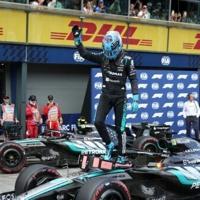
Melbourne Fireworks: George Russell's Triumphant Australian GP Win
The roar of engines, the scent of burning rubber, and the electrifying atmosphere of Albert Park set the stage for a Formula One spectacle that culminated in a truly memorable Australian GP celebration. As the checkered flag waved over Melbourne, it was Mercedes’ George Russell who emerged victorious, delivering a performance of such control and precision that it left fans and rivals alike in awe. His victory wasn't just a triumph for himself and his team; it was a powerful statement about the evolving landscape of Formula One, painting a vibrant picture of speed, strategy, and spirited competition against a backdrop of spectacular fireworks.
George Russell's Masterclass: A Symphony of Skill in Melbourne
From the moment the lights went out, George Russell showcased a masterful display of driving. The young Brit, entrusted with leading the charge for Mercedes, navigated the challenging Albert Park circuit with remarkable poise. His performance was characterized by an uncanny ability to manage both the pace of the race and the delicate life of his tires – a crucial factor on a circuit known for its demanding energy management. This wasn't merely about raw speed; it was about intelligent racing, a calculated approach that saw him consistently hit his marks and maintain a psychological edge over his competitors.
The Precision Drive: Mercedes' Dominance
Russell's controlled aggression was evident throughout. He didn't just hold the lead; he commanded it. Each lap was a testament to his understanding of the car's capabilities and the track's intricacies. The Mercedes W15, often hailed as a paragon of engineering, truly became an extension of Russell's will. His ability to extract maximum performance while simultaneously preserving tire integrity underscored the synergy between driver and machine. This strategic prowess allowed him to fend off fierce challenges, particularly from the resurgent Ferraris, demonstrating that Mercedes, under his stewardship, remains a formidable force in the constructors' championship.
The Climactic Finish: Fireworks and Fist Pumps
As the final laps dwindled, the tension around Albert Park was palpable. Every turn, every straight, was met with fervent anticipation. When George Russell finally crossed the finish line, clinching the Australian Grand Prix, the jubilation was instant and overwhelming. From the cockpit, his gloved fist shot into the air in a defiant gesture of triumph, a moment perfectly synchronized with the eruption of fireworks that lit up the Melbourne night sky. This iconic image – Russell's fist punching through the air with a kaleidoscope of colors exploding behind him – encapsulated the essence of an australian gp celebration. It was a perfect blend of determination, speed, and teamwork culminating in a champion's moment, etching itself into the annals of Formula One history as a symbol of pure sporting ecstasy.
Beyond the Track: Podium Humor and Rivalry
While the race itself was a thrilling spectacle, the celebration extended to the podium, where a delightful moment of banter unfolded between Russell and his fierce rival, Charles Leclerc. As the champagne flowed and the adrenaline began to subside, Russell, in a gesture of sportsmanship, attempted to reassure Leclerc by downplaying Ferrari's race pace. "Ferrari wasn't slow today," he might have quipped, perhaps trying to soften the blow of victory.
The Lighter Side of Competition
Leclerc, quick-witted as ever, immediately responded with a playful jab, reminding Russell of the previous day's qualifying performance: "But yesterday, mate…" This exchange, delivered with a laugh and a knowing glance, perfectly captured the unique camaraderie that can exist between these elite athletes. Despite the immense pressure and intense rivalry on track, moments like these showcase the human element of Formula One – a shared passion that often transcends the competitive divide once the helmets are off. It's a reminder that beneath the intense concentration and fierce ambition, there's a relaxed atmosphere among these competitors, allowing for lighthearted podium banter and mutual respect.
F1's Brave New World: Drama, Debates, and Daredevil Overtakes
The Australian Grand Prix also served as a crucial proving ground for Formula One's bold new era of regulations, and the verdict from Albert Park was decidedly mixed. While some hailed the changes for injecting much-needed drama, others raised significant concerns. Yet, one thing was clear: F1 is determined to avoid a "whimper" and instead deliver "a bang," a sentiment echoed by Ferrari team principal Fred Vasseur, who declared the opening 12 laps offered more fun than he had seen in F1 for a decade.
The "Overtake Mode" and Tactical Battles
Central to this new dynamic was the much-discussed "overtake mode," a system designed to encourage wheel-to-wheel action through strategic energy deployment. The initial laps saw Russell and Leclerc engage in a roaring trade for the lead, utilizing this new feature to repeatedly switch positions. Russell himself highlighted this as a "tactical fight," appreciating the complexity it added to the race. Drivers could deploy their energy at opportune moments, making overtakes possible and allowing for immediate counter-attacks. For a championship leader like Russell, whose team has mastered the new rulebook, this tactical depth was clearly a welcome addition, showcasing a blend of driver skill and engineering prowess.
Driver Concerns: The Thin Line Between Thrill and Hazard
However, the new rules were not without their detractors. Several prominent drivers, including defending world champion Lando Norris, expressed significant apprehension. Norris, who finished a commendable fifth, openly criticized the system as "artificial," warning that the repeated exchange of positions and the resulting "closing speeds of 30-50kph" could lead to a serious accident. His grim prediction that "when someone hits another driver at that speed, you are going to fly and go over the fence and do a lot of damage to yourself" cast a shadow over the excitement. It sparked an essential debate about safety and the pursuit of entertainment, highlighting a core tension in F1's current direction. His McLaren teammate, Oscar Piastri, endured a particularly tough day, much to the dismay of the local crowd who had hoped for a triumphant home performance. These safety fears added a layer of caution to the otherwise thrilling spectacle.
Ferrari's Resurgent Fight: A Glimpse of Future Battles
Despite Russell's ultimate victory, Ferrari brought a "feisty scrap" to Melbourne, confirming their intent to challenge for top honors this season. Charles Leclerc's aggressive wheel-to-wheel duels with Russell were a testament to the Scuderia's renewed competitiveness. While questions inevitably arose over some of Ferrari's strategic decision-making, their raw pace and fighting spirit promise drama yet to come. This robust challenge suggests that the 2024 season will be far from a one-horse race, with tactical battles and fierce rivalries expected at every turn.
The Verdict from Albert Park: A Season of Promise and Peril
Casting judgment on an entire season after just one race is, of course, premature. Melbourne itself is somewhat of an "outlier circuit" in terms of energy management, with its unique characteristics influencing strategic choices more profoundly than many other tracks. However, the Australian Grand Prix provided a tantalizing glimpse into the future of Formula One – a future teeming with high-octane racing, tactical intrigue, and significant debates.
What the Australian GP Tells Us About F1's Future
The race undeniably showcased the immense talent of drivers like George Russell, whose controlled and assured win confirmed the raw potential of his Mercedes package. It highlighted Ferrari's resurgence as a legitimate contender, promising thrilling multi-team battles. Yet, it also brought to the forefront critical questions about the new regulations, particularly the "overtake mode" and its safety implications. F1 must now navigate the delicate balance between creating an entertaining spectacle and ensuring the well-being of its drivers. For fans, this translates into a season poised on a knife-edge – one that promises breathtaking racing and a championship fight that could go down to the wire, but also one where the fundamental direction of the sport will be continuously scrutinized and debated.
Ultimately, the enduring image from Melbourne remains that spectacular australian gp celebration: George Russell, fist raised, fireworks exploding, symbolizing not just a personal triumph, but the vibrant, complex, and ever-evolving spirit of Formula One.